Monday, May 8, 2017

Touring History: St. John's Chapel


On Saturday, I went back to my hometown for the Monroe County (WV) Historical Society's Historic Homes Tour.

 Anticipation was high, partially due to the fact that six out of the nine stops are rarely, if ever, open to the public.


 The Historical Society had initially hoped to sell around 100 tickets, but the word on the street was that over 500 had been sold! Mine was number 243.


Obviously, I wasn't alone in my desire to see all the tour properties, but I was especially eager to see those I had grown up around, passing by hundreds of times without ever being inside.

The weather wasn't especially pleasant, with temperatures in the 40s, rain showers, and wind. Nevertheless, hosts and volunteers were ready to welcome visitors. My sister and I left her home in time to arrive at our chosen first stop by 10:00 am, when the tour officially began.

We were the first visitors to arrive at St. John's Chapel, in Sweet Springs. It is the oldest Catholic church in continuous use in West Virginia. It was founded by Letitia Preston and Floyd Lewis, and built by slaves sometime between 1839 and 1859.


Our guide met us outside to explain that when the slaves built the church, they used the best bricks for the front. Also, they somehow knew to lay the top layer of bricks at an angle, which makes a better seal when the roof is attached. You have to look closely, but you can see that top row of angled bricks in the photo below.


The original cross from the top of the steeple was found in the attic during renovations, and a new one was faithfully reproduced.


As the rain began to fall, we hurried inside. The stained glass windows let in some light, and there are electric lights here and there, but because of the gloomy day, the interior of the chapel was a bit on the dim side. Still, it was beautiful!


Renovators discovered a remnant of the original stenciling and were able to replicate it on all four walls.


The paintings hanging all around the chapel date back to its beginnings, and depict the stations of the Cross.


The pews and kneeling benches are also original.


What caught my eye first, though, was the altar.


It's hard to believe such a thing of beauty is tucked away in this tiny chapel in the mountains of southern West Virginia. I'm thinking transporting it here was quite an undertaking in the mid-1800s.


There is a balcony that runs across the back of the chapel, and up there is a working pump organ. Connie couldn't resist and played Amazing Grace. Because of all the wood and plaster in the room, the sound was glorious!


Just as Connie finished, our guide gently rang the chapel bell - such a wonderful, soothing sound.


Below is the view of the chapel from the balcony. The cables you see running horizontally held a lower ceiling that was added at some point, and has since been removed.


You can see a statue of Mary on the left end of the altar rail and a nun on the right end.


When you go through the door to the right of the altar area, you find a pot-bellied wood stove.


Continuing on to the left, behind the altar area, there is a narrow hallway. From this hall, there is a very narrow stairway, leading up to a small second floor, where the priest had meager furnishings for his living quarters. The stairs are so narrow that visitors weren't allowed to go up.


The hallway led to a small room to the left of the altar area, where the priest heard confessions. He sat in the upholstered chair, the person making his or her confessions sat on the other side of the wooden divider, and (as the guide put it) everyone in the church listened. Gulp!!


This plaque is posted on the back wall of the chapel:


There was to be a Latin Mass conducted on Sunday afternoon in the chapel, and a service is held annually in August. Even though I'm not a Catholic, I think I would like to worship here. Just like the banner hanging in the chapel says, "One Lord, one faith, one baptism." We're all God's children and He likes it when we worship Him together.


Our next stop on the tour was the Old Sweet Springs resort...which will have to wait for another post. Stay tuned!

Sunday, January 1, 2017

Butter, Butter, Who's Got Butter?

   Remember when, back in the summer, I wrote about embarking on our "milk journey?" (If you don't recall that tale, you can read about it here.) Robin and I gave it a valiant effort but, try as we might, we just couldn't keep up with five gallons of milk a day. After about two months, we were happy and relieved to find sweet LouAnn a new home.


Now she lives with a lively family with five growing children who need a lot of milk. She's such a good cow, very sweet-tempered and very patient with all the pulling, tugging, and twisting that goes along with the young ones learning to milk.


That left us with Star and her calf, which is a very good thing. The calf took all the milk unless we penned her away from her mama for eight to twelve hours. Then we could milk and manage the gallon and a half with ease. And we didn't have to milk again until we needed more. The perfect dairy life, I'd say.


But there comes a time when the calf must be weaned, and that turned out to be at the beginning of December. Now Robin is milking morning and evening again, and we're getting about two and a half gallons every day. That's still a lot of milk, but it's oh, so much more manageable than eight gallons!

These days, we're making yogurt, butter, curds, and sometimes pudding. We give some away to our little friend Kirsten, who loves it. We feed some of it to our chickens. Little Notch, our rescue cat, is growing sleek and fat on his share. But mostly, we make butter. Lots of butter!


While we had LouAnn, there was so much cream that Robin dug out the old electric churn his mother and aunt used decades ago. This thing is somewhere between vintage and antique, probably from the 1940s. With some coaxing and TLC, it still works. These photos are from our first time using it. We put in about two gallons of cream and the dasher,


and then got the tank all settled in the frame and hooked up to the motor on top.


Robin plugged it in, and wa-laa! It worked! It was a bit noisy and he had to sit with it to make sure the lid didn't bounce off, but in about half an hour we had butter.


However, it wasn't right. It was too fluffy, more like cake icing and almost white.


I managed to get it washed and packed, but it was quite a mess. All that fluff ended up being made into ghee, a wonderful substance that I use for frying and oiling bread pans, among other things. But that's another story.

In the almost 30 years since we made butter, we had forgotten that one must add some milk to the cream in order for the butter to form. Once we did that, we ended up with real butter.


After LouAnn went to her new home, we didn't have enough cream for the big old electric churn, so we went to the manual method.


This old glass churn really is an antique, but it still works just fine as long as you supply the power.


We also remembered another nugget of churning wisdom: let the cream and milk come to room temperature. Doing so cut the churning time almost in half, from close to an hour down to 20 minutes, give or take a few.


After the buttermilk is poured off


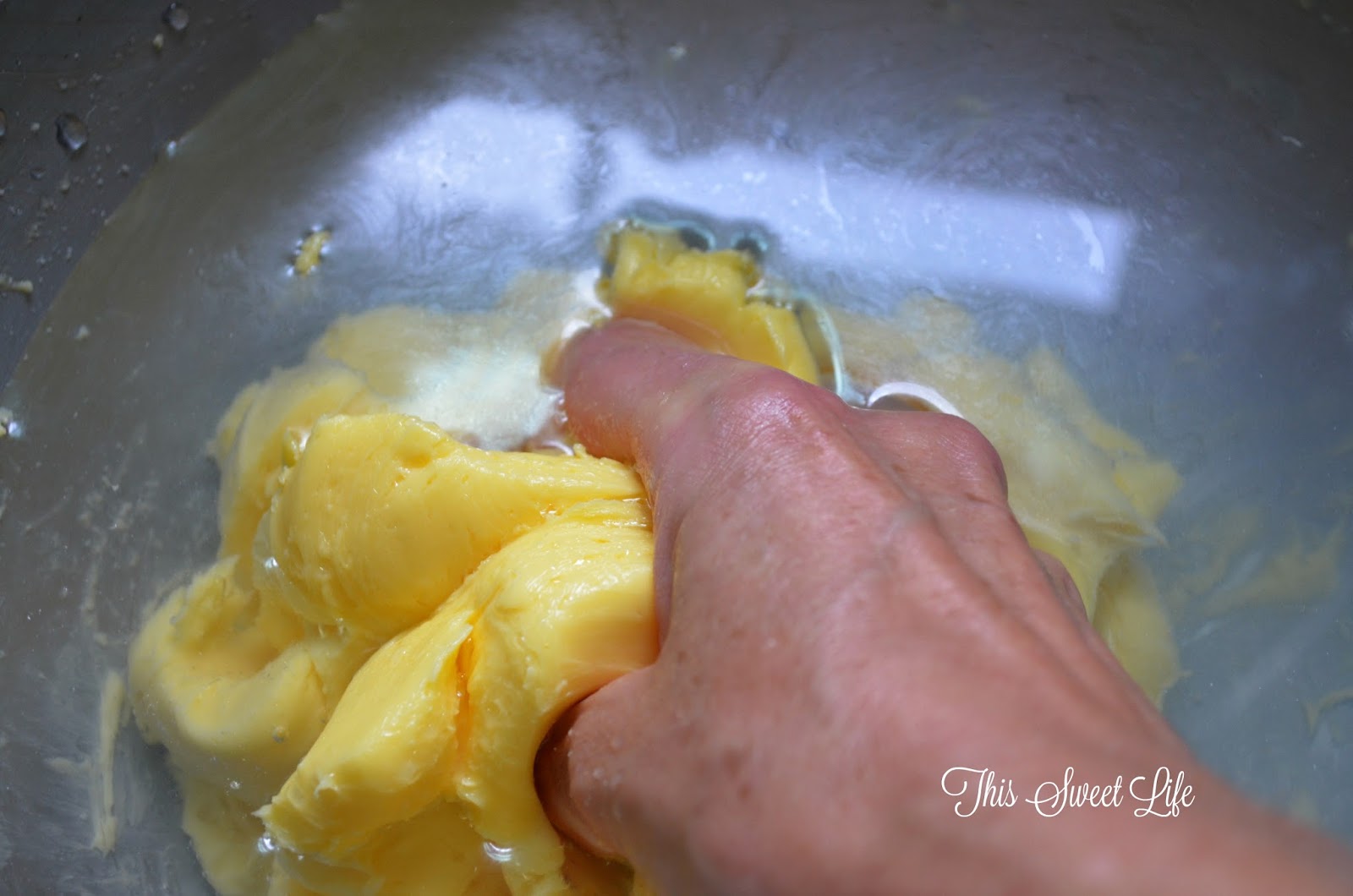
the washing begins. Did you know you must wash the milk out of the butter?


Simply add cold water and start squeezing.


It takes several rounds of squeezing, pouring off the water, adding clean water, and squeezing some more to get all the milk out.


Then you squeeze more to get as much water out as possible, add salt, and squeeze and pat some more. When the salt is all mixed in and most of the water is out, you're ready to pack.


Butter freezes well, so once it's solid inside these containers, we pop it out, wrap it in plastic wrap, and pack the butter blocks in zip-top bags. We have quite a stash now. And the cream keeps coming.

This past Saturday, we bought a more "modern" electric churn from the same folks we bought the cows from.


Isn't she a beauty? She needed a good bit of scrubbing and a new cord, which we took care of right away. Now she's as good as new.


There's even an on/off switch


and a pretty red handle.


Maybe she needs a name. Hmm...I'll have to think about that a while. I'm open to any suggestions you may have. Anyway, we loaded her up with three quarts of cream and a quart of milk...


put the dasher/motor/lid on, plugged her in, and turned her on.


My! How quiet she runs! Just a soft whir on my kitchen counter. How nice it was to turn her on and walk away while the she did the work.


After about 30 minutes, she sounded like she was working a little harder. Sure enough, butter was starting to form.


We let her run a few minutes more and there it was! Beautiful, golden butter floating in the milk, and we barely had to lift a finger. What a wonder!


From there on, it was the same process of washing and packing. I was so delighted with what's her name that I forgot all about taking pictures.

Along with the churn came this handy butter mold, which also worked like a charm. It holds a pound and you can cut it into four sticks, just like store-bought butter. That's great for cooking and baking, where measurements matter.


I think we've finally come to an even keel in our milk journey. Star will be milking for another month or two. She's hopefully bred again, with a calf due in late summer. She'll be dry for a few months while her baby grows, meaning she won't give any milk. Never fear, though! We have plenty of butter to get us through until she freshens with a new calf. Then we'll be back in the dairy business again.